








AIDEVI Wellness Guide
What Is an nmn Supplement? Human Evidence, Benefits & Safety
An NMN supplement provides nicotinamide mononucleotide, a precursor involved in the body’s NAD+ pathway. Small human trials suggest that oral NMN can raise blood NAD+ under specific study conditions, but a biomarker change does not establish longer life, disease prevention, or a guaranteed improvement in how you feel. This guide explains what NMN is, what human research has measured, and how to assess a product’s label, quality information, and safety limits.

- NMN and NAD+ are related but different molecules; NMN is discussed as a precursor in NAD+ metabolism.
- Human studies have measured NAD+ levels, tolerability, and selected physical or metabolic outcomes.
- Current trials do not establish NMN as a way to reverse aging, prevent disease, or deliver a specific result for every user.
- Compare the stated ingredient amount, full serving, other ingredients, batch documentation, and product directions as separate label checks.
On this page
What is an NMN supplement?
NMN is short for nicotinamide mononucleotide. It is a molecule involved in the pathway that supplies nicotinamide adenine dinucleotide, or NAD+. NAD+ participates in cellular redox reactions and energy metabolism. Researchers study this pathway because NAD+ is used by many cellular enzymes and because NAD+ biology can vary with age, tissue, health, and other conditions. Those mechanisms explain the research interest; by themselves, they do not show what taking a supplement will do for a person.
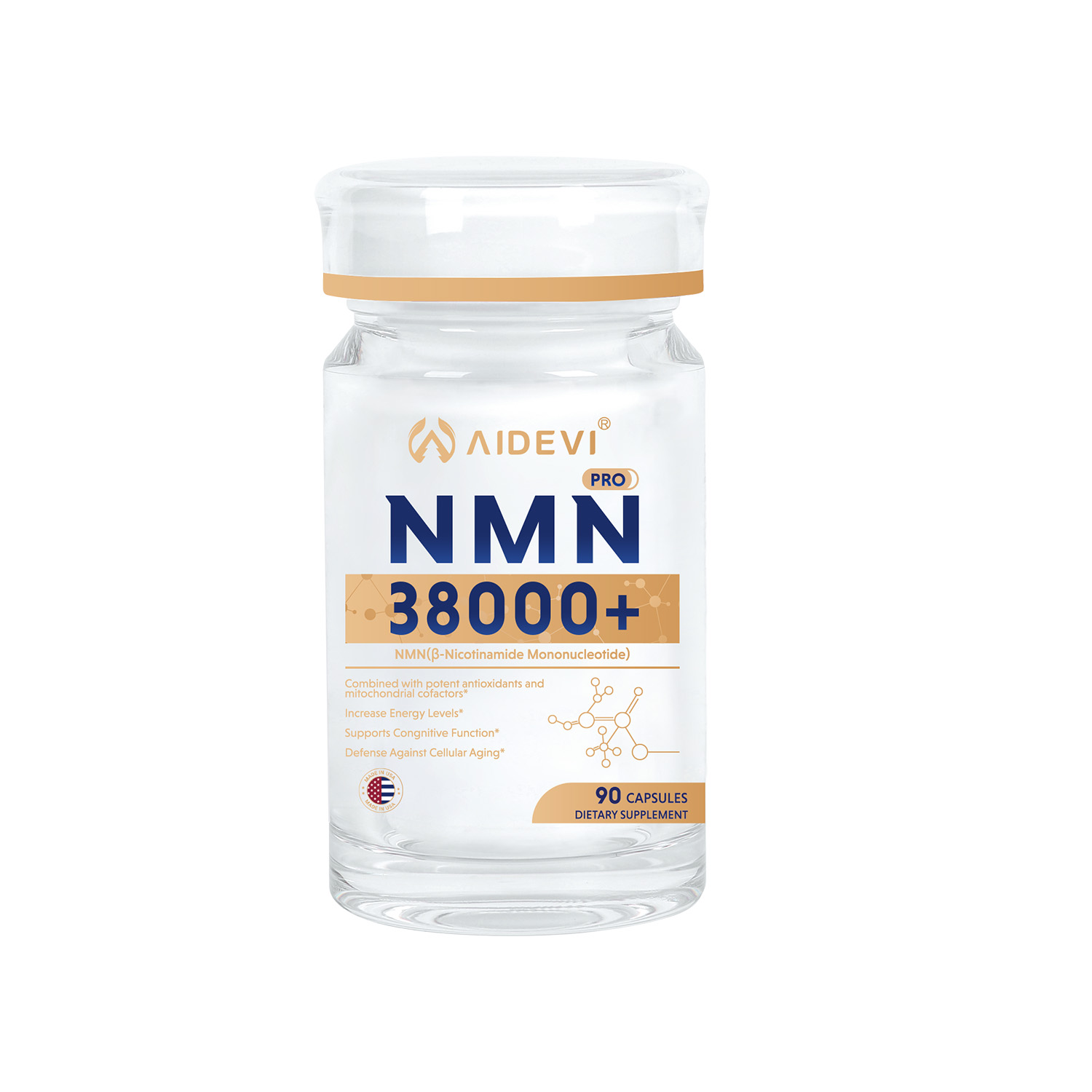
An NMN supplement is a consumer product containing NMN as one ingredient, either alone or alongside other active ingredients. The word “NMN” on a bottle does not tell you the amount per capsule, the amount in a full serving, whether the formula is a blend, or how the product was tested. It is useful to keep three questions separate: what NMN is, what a human study found, and what a particular product label says.
NMN is not the same compound as NAD+, nicotinamide riboside (NR), or niacin. Each relates to NAD+ metabolism in a different way, and an ingredient comparison should not assume that products are interchangeable. For the terminology and pathways, see AIDEVI’s comparison of NMN, NAD+, and NR.
What have human studies found about NMN?
The most informative question is what researchers measured and for how long. A randomized, placebo-controlled trial in 30 healthy adults assigned 15 participants to 250 mg of NMN per day and 15 to placebo for 12 weeks. The researchers reported an increase in whole-blood NAD+ in the NMN group and no obvious adverse effects during the study period [1]. This supports a specific conclusion: under that study protocol, NMN changed a measured blood biomarker. It does not establish that every product or person will respond in the same way.
A 2026 systematic review and meta-analysis included 15 trials, with 10 contributing to its safety analyses. Tested amounts ranged from 250 to 2,000 mg per day, and study periods ranged from 14 days to 24 weeks. The review found no significant broad effects on body weight, BMI, fasting glucose, HbA1c, lipid profiles, or systolic blood pressure. It also found no significant increase in pooled adverse events or liver enzyme markers in the short-term trials [2].
The review noted exploratory signals for outcomes such as diastolic blood pressure and insulin-resistance measures, but the authors considered them uncertain and in need of larger, longer studies. A finding that does not reach statistical significance is not proof of a benefit, and a change in a lab marker is not automatically a meaningful improvement in health. AIDEVI’s NMN and metabolic-health research guide examines that distinction in more detail.
| Research question | What current human evidence can say | What it cannot establish |
|---|---|---|
| Blood NAD+ | Some short trials report higher blood NAD+ after oral NMN. | A guaranteed response in every tissue, product, or person. |
| Metabolic markers | Researchers have tested glucose, lipids, blood pressure, and related measures. | Broad or clinically meaningful metabolic benefits for the general population. |
| Short-term tolerability | Available trials have not shown a clear increase in pooled short-term adverse events. | Long-term safety or safety for every health condition and medication combination. |
| Healthy aging outcomes | The biology is being studied in people. | Reversal of aging, longer lifespan, or prevention of age-related disease. |
Which potential NMN benefits are not established?
A mechanism is a reason to conduct research, not a substitute for a human outcome. NAD+ is involved in cellular processes connected to energy metabolism, but that does not prove that an oral NMN product will make someone feel more energetic, think more clearly, look younger, or live longer. These outcomes need to be tested directly with well-designed studies that follow enough people for long enough.
The same care applies to claims about diabetes, heart health, brain health, cancer, or other diseases. The current evidence does not establish NMN as a treatment or disease-prevention strategy. People should not use an NMN supplement in place of prescribed care, screening, or advice from a qualified healthcare professional. A responsible summary is narrower: NMN is a subject of NAD+ research, some human studies report blood NAD+ changes, and broader health benefits remain uncertain.
Study results can differ because participants, baseline health, NMN formulations, amounts, study length, and measured endpoints differ. This is one reason a study dose should not be treated as a personal dose recommendation. If you are comparing research quantities with the serving information on a product, use AIDEVI’s guide to NMN 250 mg versus 500 mg research and label amounts as a label-reading resource, not a prescription.
How do you compare NMN supplements?
Begin with verifiable product facts rather than longevity promises. A clear label helps you understand what the product contains; quality documentation may answer questions about a tested sample. Neither one proves that the product will produce a clinical benefit.
| Check | What to look for | Keep in mind |
|---|---|---|
| Ingredient and amount | The named NMN form and amount per capsule, tablet, scoop, packet, and full serving. | The amount per unit may differ from the complete serving or the total amount in the bottle. |
| Other active ingredients | The complete Supplement Facts panel and serving directions. | A blend changes the formula being evaluated and may affect precautions. |
| Product form | Whether the product is a capsule, powder, or a product specifically labeled for another route. | Format alone does not prove better absorption or effectiveness. |
| Quality information | Whether a certificate identifies the tested sample, batch, laboratory, method, specification, and result. | A COA can support specific quality checks; it cannot prove clinical results. |
If a brand provides a Certificate of Analysis (COA), check that it is relevant to the product and batch you are evaluating. A raw-material report and a finished-product report answer different questions. Read the lab name, test method, specifications, actual results, and sample identifiers together rather than relying on a single purity figure. AIDEVI’s guide to reading an NMN certificate of analysis explains how to check those details. For common warning signs in online listings, see the NMN buyer’s checklist for spotting counterfeit claims.
Format is a practical choice as well as a research question. Capsules provide a countable unit; powders require following the product’s measuring directions. “Sublingual” describes a route and should only be used when the exact product is labeled for it. For those trade-offs, continue to AIDEVI’s comparison of NMN powder, capsules, and sublingual products.
What are the safety limits of NMN supplements?
Short-term clinical trials have not shown a clear increase in pooled adverse events or liver enzyme markers, which is reassuring for the study periods and participants examined. It is not proof of long-term safety. The 2026 review included studies lasting from 14 days to 24 weeks and noted limits in sample size, follow-up, and the number of serious events. Rare, delayed, or population-specific risks cannot be ruled out from a short trial dataset [2].
Do not assume that a research protocol is right for your circumstances. A supplement may contain ingredients in addition to NMN, and those ingredients can introduce separate considerations. Anyone who is pregnant, nursing, taking medication, managing a medical condition, preparing for surgery, or concerned about a reaction should consult a qualified healthcare professional before starting or changing a supplement. Stop use and seek advice if you experience a concerning or persistent reaction.
For questions about possible reactions and when to ask for help, see AIDEVI’s NMN effects and side-effects guide. For general routine questions, the article on NMN with coffee or breakfast discusses practical timing without replacing product directions or professional guidance.
A practical way to think about NMN
A useful NMN decision starts by naming the goal. If you are trying to understand NAD+ biology, focus on the pathway and the limits of the evidence. If you are comparing products, check the exact amount per serving, all active ingredients, route, storage directions, and batch-specific documentation. If you are considering NMN because of a symptom or diagnosis, discuss that with a healthcare professional rather than treating a supplement as a substitute for care.
The evidence is developing, and the most accurate summary is also the most useful: NMN is an active area of human research; some trials report higher blood NAD+; broader health outcomes and long-term safety remain uncertain. Use that boundary to set expectations, compare labels, and decide what question you need answered next.
Frequently Asked Questions
What is NMN in a supplement?
NMN is nicotinamide mononucleotide, a molecule involved in the body’s NAD+ pathway. A supplement may contain NMN alone or in a formula with other ingredients. Check the complete label to see the amount per unit and per serving.
Does NMN increase NAD+ in humans?
Some human studies report increased blood NAD+ after oral NMN under the tested conditions. That finding does not guarantee the same response for every person, product, tissue, or health outcome [1].
Is NMN the same as NAD+ or NR?
No. NMN, NAD+, and NR are distinct molecules related to NAD+ metabolism. Their roles and supplement formats should not be treated as interchangeable; see the NMN, NAD+, and NR comparison for a closer look.
Does NMN have proven anti-aging benefits?
Human evidence does not establish NMN as a way to reverse aging, extend lifespan, or prevent age-related disease. Researchers continue to study NAD+ biology and selected health outcomes, but more and longer trials are needed.
Is NMN safe for long-term daily use?
Current trials provide limited short-term information, not a definitive answer about years of use or every health context. Follow the product label and speak with a healthcare professional if you have a medical condition, take medication, are pregnant or nursing, or have a safety concern [2].
References
- Okabe K, et al. Oral Administration of Nicotinamide Mononucleotide Is Safe and Efficiently Increases Blood Nicotinamide Adenine Dinucleotide Levels in Healthy Subjects. Frontiers in Nutrition. 2022;9:868640.
- Yang W, et al. Safety and Metabolism-Related Outcomes of Oral Nicotinamide Mononucleotide Supplementation in Adults: A Systematic Review and Meta-Analysis. Nutrients. 2026;18(14):2251.
Individual results may vary. Consult a healthcare professional before starting any new supplement, especially if pregnant, nursing, taking medication, or managing a medical condition. These statements have not been evaluated by the Food and Drug Administration. This product is not intended to diagnose, treat, cure, or prevent any disease.
